
Article: Dog Bed Fillings Explained: Foam, Wool & Polyester

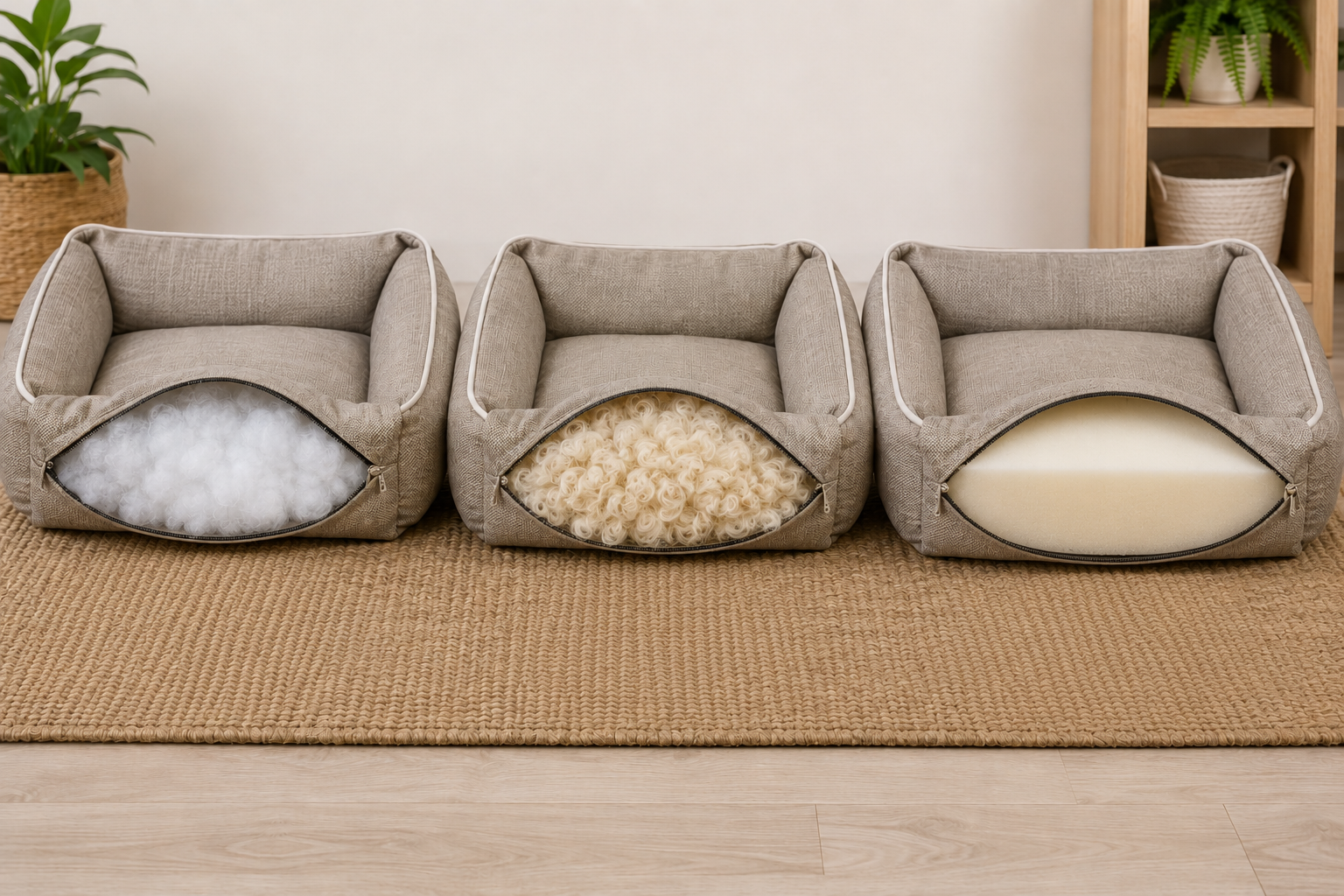
Dog Bed Fillings Explained: Foam, Wool & Polyester
When shopping for a dog bed, most of us focus on the outside. The cover fabric, the colour, the shape, and how soft it feels all get attention. The filling inside, the part that determines comfort, support, and longevity, often gets overlooked.
The problem is that those first impressions rarely last. Over time, the plush surface can flatten, the filling may shift, and the bed can lose some of the comfort and support that made it appealing in the first place. And if you've ever bought a bed labelled "orthopedic" only to watch it compress noticeably within a few months, you're not alone. The label means far less than most people realize.
What's inside the bed is what actually determines how your dog sleeps, how long the bed holds up, and what materials your dog spends every night lying on.
Here’s a practical look at the three most common fillings.
Polyester Fibre – Soft but Short-Lived
Polyester fibre is by far the most common filling in dog beds as it's what's inside the majority of beds you'll find at pet stores and big box retailers. It feels great on day one. But what most people don't realize is that polyester is, at its core, a plastic, spun into fibre form, but plastic nonetheless.
Under a dog's weight, polyester fill can clump, flatten, and bunch into corners. Once it loses loft, it usually doesn't recover well. That is why many polyester-filled beds feel soft at first but start looking tired quickly.
And because polyester is plastic, it behaves like plastic. Research published in Environmental Science & Technology found that polyester textiles release microplastic fibres, one of the many reasons synthetic materials are receiving increased scrutiny.
Polyester fill is inexpensive and widely available, but if the bed needs replacing again and again, the real cost can add up faster than the price tag suggests.
Foam – Not All Support Is Equal
Foam dominates the premium end of the dog bed market, particularly anything marketed as orthopedic or supportive. And the quality range is enormous.
Here's the issue: the word "orthopedic" has no regulated definition in the pet industry. Any manufacturer can print it on a bed regardless of what's inside. A $40 foam bed and a $200 foam bed can both call themselves orthopedic - and both often do.
What actually determines support is foam quality, especially density. Higher-density foams generally resist permanent compression longer and provide more consistent support over time. Unfortunately, most dog bed brands don't publish foam density, which makes meaningful comparisons difficult.
A couple of other things are worth knowing. Polyurethane foam, the base material in most foam dog beds, can release volatile organic compounds, or VOCs, when new. Research published in Polymer Degradation and Stability found that flexible polyurethane foams can emit VOCs after production, with emissions changing over the first several weeks. That doesn't mean every foam dog bed is unsafe, but it does make airing out a new foam bed a sensible step, especially for dogs with respiratory sensitivities.
Foam also tends to retain heat. Some dogs love that. Others, especially large breeds or dogs who already run warm, may sleep less comfortably on it. And lower-density foams often develop permanent compression over time. Higher-density foams last longer, but eventually all foam loses some resilience.
Wool – Nature's Performance Fibre
Wool rarely gets attention in the pet bed market, which is surprising once you look at what it actually does. Wool fibres are naturally crimped, creating tiny air pockets throughout the fill. This structure helps wool balance softness, resilience, breathability, and moisture management in a way synthetic fills often struggle to match.
It regulates temperature naturally. Wool can absorb moisture vapour without feeling wet, then release it gradually as conditions change. This creates a natural buffering effect that helps keep the sleep surface more comfortable across different seasons. Dogs who tend to overheat, and many do, may settle better on breathable materials than on heat-retaining foam or dense polyester fill.
It holds its shape. Wool fibres compress under weight and spring back when the pressure releases. Unlike foam, which can permanently deform, or polyester fill, which can clump and collapse, a well-made wool bed can maintain its comfort for years.
It can be refreshed rather than replaced. One of wool's biggest advantages is that the filling can be topped up over time. Instead of throwing away an entire bed when it starts to lose loft, you can restore comfort by adding fresh wool. That means less waste, lower long-term cost, and a bed that can stay comfortable far longer than most synthetic alternatives.
It doesn't shed microplastics. Wool is a natural protein fibre, keratin, the same family of material as hair and nails. It doesn't release synthetic plastic fibres during washing or normal use, making it a cleaner material choice for your home and the environment.
It may also be less hospitable to dust mites. Wool's moisture-regulating properties can help create conditions that are less favourable for dust mites compared with materials that trap humidity. That can be a practical benefit for dogs with sensitivities, though no material should be treated as a cure-all for allergies.
So Which Should You Choose?
If your vet has recommended high-density support for a dog with serious joint issues, look for a reputable foam bed that publishes meaningful details about its materials rather than one that simply uses the orthopedic label. For dogs with arthritis, hip dysplasia, or mobility challenges, quality foam may be the most appropriate option.
For most dogs, wool is an excellent long-term choice. It is breathable, naturally resilient, refillable, and free from synthetic microplastic shedding. It also performs well across Canada's seasonal temperature swings, from dry winter interiors to warm summer days.
Polyester-filled beds have their place too. They're inexpensive, lightweight, and widely available. Just go in knowing what you're buying. While they often feel plush at first, they tend to flatten more quickly than wool or quality foam and are usually the least durable option.
About Wagging Tailor
Wagging Tailor dog beds are filled with 100% Canadian wool — a naturally breathable, resilient filling that stays comfortable through every season. Unlike beds designed to be thrown away when the filling breaks down, our wool beds can be refreshed, repaired, and used for years. Combined with our interchangeable washable covers, it's a bed designed for long-term comfort rather than short-term convenience.
Shop Complete Bed Sets
Sources
Microplastic Shedding from Polyester Textiles Hernandez, E., Nowack, B., & Mitrano, D.M. (2017). Polyester Textiles as a Source of Microplastics from Households: A Mechanistic Study to Understand Microfiber Release During Washing. Environmental Science & Technology, 51(12), 7036–7046. DOI: 10.1021/acs.est.7b01750.
Volatile Emissions from Polyurethane Foam Hornyák-Mester, E., et al. (2023). Volatile Emissions of Flexible Polyurethane Foams as a Function of Time. Polymer Degradation and Stability, 214, 110507. DOI: 10.1016/j.polymdegradstab.2023.110507.
Wool Moisture Management & Breathability International Wool Textile Organisation (IWTO). Facts About Wool: Moisture Management, Breathability and Comfort. Available at: https://iwto.org

Written by Wagging Tailor