
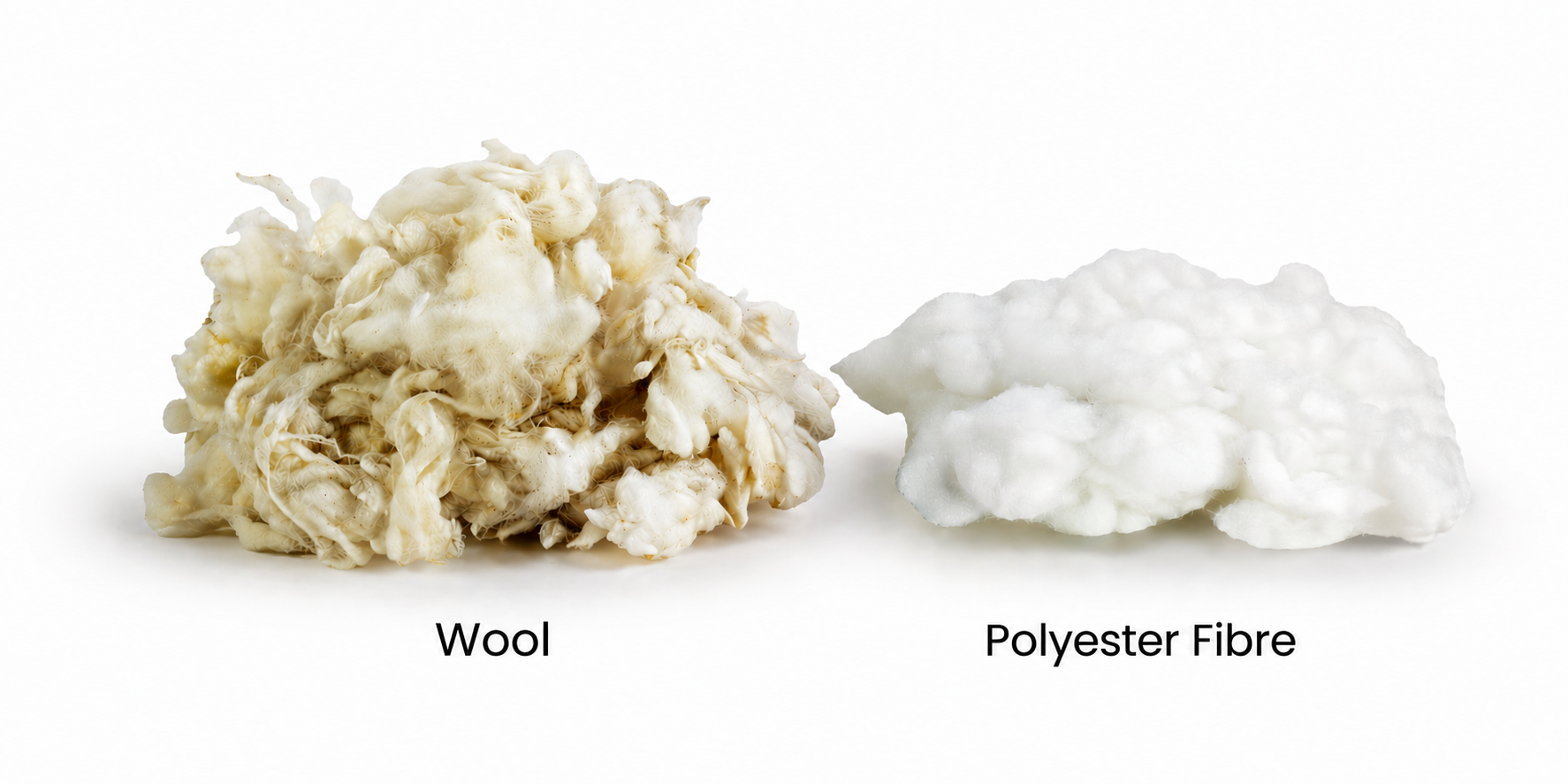
Is a wool dog bed better than synthetic?
Your dog spends up to 16 hours a day on their bed — and most modern beds are essentially "plastic pillows," filled with polyester clusters or polyurethane foam. While cheap to produce, these synthetic materials come with hidden trade-offs for your home, your dog, and our planet.
At Wagging Tailor, we use what nature already perfected. Our 100% Canadian natural wool stuffing is high-performance, long-lasting, and completely plastic-free.
Wool vs. synthetic compared
|
Natural wool
Wagging Tailor
|
Synthetic polyester
Other beds
|
|
|---|---|---|
| Temperature |
Adaptive.
Wicks moisture and traps air to keep dogs cool in summer and warm in winter. |
Traps heat.
Non-breathable fibres often lead to hot spots and panting during sleep. |
| Odour & hygiene |
Self-cleaning.
Lanolin and scales on the fibre naturally repel bacteria, mold, and dust mites. |
Traps odour.
Oleophilic (oil-loving) fibres absorb dog oils and hold onto smells over time. |
| Durability |
20,000+ bends.
Wool fibres are incredibly resilient; they won't lose their loft or support after years of daily use. |
~3,000 bends.
Polyester clusters flatten quickly, leading to pancaked beds that end up in landfills. |
| Microplastics |
Zero.
Naturally biodegrades in soil or water within months. |
High.
Sheds millions of microplastic fibres into the air and water with every wash. |
| Chemical safety |
Pure.
Naturally flame-resistant and free from VOC off-gassing. |
Treated.
Often requires chemical flame retardants and may release new-bed chemical smells. |